
Keep Amazon dronesout of Portland
Amazon is proposing a Prime Air drone delivery operation from its North Portland fulfillment center. Routine commercial drone delivery does not belong over Portland neighborhoods. This site tracks the proposal, the evidence—especially around noise—and the public process.
Take actionWhat Amazon is proposing in Portland
Amazon says it plans to add a Amazon’s name for the on-site hub where its delivery drones would launch and return. FAA materials ↗—an on-site drone hub—to its North Portland fulfillment center and begin deliveries in early 2027. Prime Air Amazon’s electric delivery aircraft model discussed in the proposal and FAA noise report. FAA-hosted report ↗ drones would take off from the site, follow a set flight path, lower packages at delivery points, and return to the center.
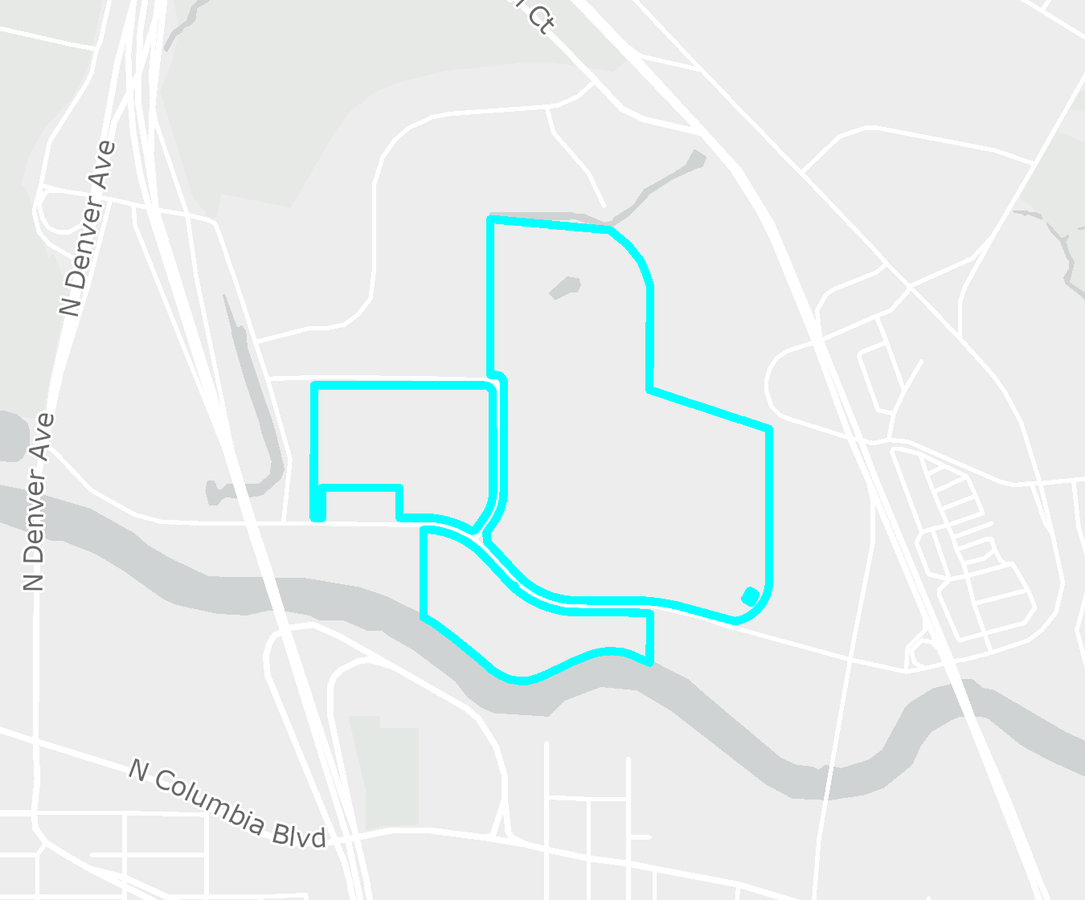
Portland, Oregon 97217Amazon's September 9, 2026 application narrative identifies this as the proposal address. City records also reference 1001 N Schmeer Rd for the same property.
A maximum operating range of 7.5 miles
The FAA's Amazon Prime Air Baton Rouge, Appendix E: Noise Analysis Methodology lists a maximum operating range of 7.5 miles. This is the aircraft's maximum technical range from the facility, not an announced Portland service area. Amazon has not disclosed Portland delivery boundaries. A 7.5-mile radius reaches far beyond the neighborhoods next to 515 N Schmeer Rd and across much of North and Northeast Portland.
What Amazon's application describes
In its September 9, 2026 application narrative, Amazon proposes flights every day from 30 minutes before sunrise to 30 minutes after sunset. In June in Portland, that is roughly 4:50 a.m. to 9:35 p.m., calculated from published sunrise and sunset times. The application does not say how many flights per day it plans.
Amazon says the landing area would be in the service court of the existing warehouse, enclosed by jersey barriers or fencing. Its narrative describes vertical takeoffs, set routes at 200 to 400 feet, and package drops from about 13 feet.
The noise figures in Amazon's application do not say what they measure or the distance at which they were measured.
Amazon is proceeding with the first step in A City land-use review that includes public notice, a hearing, and a decision. The pre-application conference is an early step, not the formal application. Portland’s guide ↗.
Portland’s August 17 Zoning Analysis concluded that Amazon’s proposed takeoff and landing area is a The City’s zoning category for a site where helicopters take off and land. Portland’s analysis applies this classification to the proposal; Amazon disagrees. requiring a Type III Conditional Use Review. Amazon is proceeding with the pre-application conference. A PP&D senior planner described it as the first step in that process. Amazon's September 9, 2026 application narrative states that Amazon and the FAA do not consider the PADDC an HLF or the MK30 a helicopter, while Amazon proceeds with the City's process.
Latest update · Sept. 23: A PP&D senior planner described the conference as the first step in Type III review and said PP&D could reconsider its use determination. Read the update ↓
Portland Land Use Services concluded that Amazon's proposed drone operation must be treated as a Helicopter Landing Facility (HLF)—the City's zoning category for a site where helicopters take off and land. Amazon explicitly disagrees with that classification.
The City's Complex Zoning Analysis 26-055262 PR says the proposed drones are rotor-powered aircraft with substantially vertical rotor axes and “must be considered helicopters under zoning regulations,” so their takeoff and landing site must be considered a Helicopter Landing Facility. This is the City’s zoning analysis, not a final land-use decision.
Why this matters
A PP&D senior planner said in a Sept. 23 email that the pre-application conference is the first step in the Type III Conditional Use Review. Amazon is proceeding with the conference while maintaining its disagreement with the HLF and helicopter classifications. The conference is distinct from a later formal Conditional Use application, public notice, and hearing. The City could reconsider its use determination; the email was a clarification of process, not a formal land-use decision.
AMAZON'S SEPTEMBER 9 SUBMISSION
Amazon says it and the FAA do not consider the PADDC an HLF or the Prime Air MK30 a helicopter. Amazon is proceeding with the pre-application conference as the first step in the City’s Type III path while expressly disagreeing with the classification.
- 01Pre-application conferenceFirst step in Type III review; Early Assistance application received Sept. 17, conference scheduled Oct. 20, 2026.
- 02Noise Review Board approvalBefore submitting a Conditional Use application, Amazon must obtain approval from the five-member Noise Review Board. The board meets virtually each month on the third Wednesday at 6:00 p.m. (PCC 33.243.050.B)
- 03State aviation provisional approvalAmazon must also obtain provisional approval from the State of Oregon Aeronautics Division before submitting the Conditional Use application. Whether FAA approval is required is an open question being pursued. (PCC 33.243.050.C.1)
- 04Formal Conditional Use applicationA separate formal application may follow the conference and required approvals; PortlandMaps currently lists the Early Assistance case only.
- 05Public notice & hearingLater steps in Type III review include public notice and a hearing.
- 06Decision & possible appealA Type III decision may be appealed through the process described below.
After a public hearing, the Hearings Officer decides the Conditional Use application. An appeal of that decision goes to Portland City Council, acting in a quasi-judicial role, and then to the Oregon Land Use Board of Appeals (LUBA), which reviews the record built below.
Put your concerns in writing
To appeal, you generally must participate in the local proceeding. Separately, an issue not raised in the local record with specificity is waived for everyone, including people who did participate (ORS 197.835(3)). Connect your comments to the approval questions in What the City is deciding.
Routine delivery drones would add a recurring source of aerial noise to Portland neighborhoods.
Noise is not only a question of one decibel value. The duration, frequency content, tonality, and fluctuation of a sound can shape how people experience it. The FAA-hosted MK30 testing and peer-reviewed drone-noise research below give readers documented measurements and context for assessing that concern.
What the City is deciding
The City is not deciding whether drone delivery is a good idea. It is deciding whether this facility meets requirements already in Portland's code. A hearings officer will go through those requirements and check each one.
The main questions are whether Amazon can show the facility has state and federal aviation approvals; whether it will have a bigger impact than warehouse uses already allowed on the site, and if so, whether the public benefit is worth the harm; whether it meets City and state noise rules; and whether it can reasonably be combined with an existing nearby facility.
For anyone writing to the City, comments that speak to these questions carry weight. General opposition does not. The 500-foot location factor is one consideration, not the test itself. It measures the landing pad's distance from residentially zoned land, while delivery flights spread impacts outward along routes over surrounding neighborhoods. A pad distance alone does not describe those flight path impacts. The distance factor was written for conventional helicopter facilities, where impacts are concentrated at and near the pad.
If the City approves the facility, it can attach conditions, such as limits on hours or flights, required flight logs, and an expiration date that requires another public hearing.
Hear what drone delivery can sound like
82.8 dBA at the lateral microphone. What does that measure?
The FAA-hosted report’s Table B-2 lists this as the average of measured Lmax values from max-weight delivery tests at a microphone 25 feet laterally from the delivery point. The aircraft averaged 92 feet in altitude for those measurements.
This is a test measurement, not a prediction for a Portland home. Noise at any location would depend on operating conditions, distance, flight path, and other factors.
FAA-hosted MK30 report, Appendix E, Table B-2 ↗Drone noise can draw more attention
In a controlled study, two drone types were rated more annoying than cars and other aircraft at the same sound exposure level. The study examined other drone types, and a research review says evidence remains limited. Peer-reviewed study ↗ · Research review ↗
One flight is an event. Repeated flights become the soundscape.
Reports from cities with drone programs and Amazon’s own filings illustrate the scale of delivery-drone activity—from repeated neighborhood overflights to proposals for up to 1,000 flights per operating day.
overflights in 10 hours
A resident told City Council the log tracked passes directly over one home.
drone movements in one hour
A reporter observed about 25 departures and 25 arrivals at Amazon’s Papillion facility.
flights per operating day
Amazon proposed this limit for Prime Air Drone Delivery Centers at other hubs in FAA environmental materials.
Take action
Choose how you want to engage with Portland's review of the Prime Air proposal.
Ask Portland to stand by its Helicopter Landing Facility analysis
Portland’s August 17 Zoning Analysis concluded that Amazon’s proposed takeoff and landing area is a Helicopter Landing Facility requiring Type III Conditional Use Review. Tell PP&D you support retaining and applying its current interpretation as it reviews the proposal and any subsequent land-use application.
503-823-7300 · [email protected]Contact your district liaison about neighborhood impacts
Explain how routine drone delivery would affect your neighborhood, and ask your district liaison to share those concerns with planning staff. Ask them to support the City retaining and applying its existing Helicopter Landing Facility interpretation. Portland's current code already sets a high bar for these facilities; the question before the City is whether it will apply that code as written.
Comments about this application belong in the land use record
A note on contacting City Council. If Amazon's application is approved or denied, that decision can be appealed to City Council, which would hear it in a quasi-judicial role, like a judge. Once a formal application is pending, private contact with councilors about this specific case must be disclosed and can complicate the proceeding. General conversations about drone policy are always appropriate. Comments about this application belong in the land use record, not in a councilor's inbox.
Know when public comment opens
Sign up to receive notice when the opportunity to submit testimony during a formal land-use hearing arises, along with important updates on Portland’s review.
Contacting City staff or elected officials now is separate from testimony in a formal hearing later. When a hearing is scheduled, follow its notice for how and when to submit land-use testimony.
Read the record for yourself.
City interpretations, Amazon's account, independent technical analysis, and peer-reviewed research are kept distinct. Supplied application documents are cited by file number when no stable public copy is available.
City Complex Zoning Analysis · case 26-055262 PR · Aug. 17, 2026. This City analysis and Amazon’s narrative were emailed to us by a City senior planner after we requested them. We do not link or reproduce our copies. Readers may request the active case records from Portland Land Use Services. These documents are not final land-use decisions.
Amazon’s position in this submission is distinct from the City’s analysis and from this site’s advocacy position. Request the active case record from Portland Land Use Services.
Prime Air collected the test measurements; ESA analyzed them with FAA coordination. The report includes scenarios beyond Portland. The available MK30 noise data was produced by the applicant. If no independent measurements are placed in the record, Amazon's figures become the official noise facts considered in this case.
Recent developments.
A running record of application activity, City communications, and other significant developments.
Portland's Early Assistance record lists the meeting for 10:30 a.m.
In a Sept. 23 email, a PP&D senior planner said Amazon’s pre-application conference is the first step in Type III review. Amazon’s Sept. 9 submission says that Amazon and the FAA do not consider the proposed facility an HLF or the MK30 a helicopter. The planner said PP&D could reconsider its use determination. A later Conditional Use decision may be appealed through the applicable process. No reconsideration is identified as pending. The email is not a formal land-use decision.
The Noise Office said it had not received an Amazon noise-variance application and did not expect a variance item on the Oct. 21 agenda. This confirms only that no variance application was pending. A separate Noise Review Board approval is required before a Conditional Use application may be submitted (PCC 33.243.050.B); the status of that approval has not been confirmed.
Portland intake record lists case EA 26-068984 PC.
For officials, organizations, and reporters
This section collects the technical and code detail for readers working directly with the land use record. Organizations and counsel can use the existing email signup to get in touch.
Approval criteria
The Conditional Use Review asks whether the facility meets these approval criteria:
- PCC 33.815.210.A.1: The facility meets safety standards required by state or federal agencies. The facility must be approved by State Aeronautics and the FAA.
- PCC 33.815.210.A.4: In C, E, I, or CI zones, the facility will not have greater impact than allowed uses. If impacts are significantly greater, public benefits must outweigh the harm. Locations more than 500 feet from land with residential zoning are viewed more favorably.
- PCC 33.815.210.A.7: The facility meets Oregon Department of Environmental Quality and City noise regulations.
Approval may also depend on whether the facility can reasonably be combined with an existing nearby facility.
Requirements before a Conditional Use application
The applicant must obtain Noise Review Board approval before submitting a Conditional Use application (PCC 33.243.050.B), and provisional approval from the State of Oregon Aeronautics Division before submission (PCC 33.243.050.C.1). For facilities that require FAA approval, the applicant must file FAA Form 7480-1, “Notice of Landing Area Proposal,” before a building permit issues (PCC 33.243.050.C.2).
If the proposal cannot meet Title 18 noise regulations, a noise variance is a conditional fallback (PCC 33.243.060.G). This is separate from the required Noise Review Board approval.
PortlandMaps zoning and overlays
PortlandMaps lists split base zoning at the property: EG2hk (General Employment 2, with Aircraft Landing and Prime Industrial overlays), IG2chk (General Industrial 2, with Environmental Conservation, Aircraft Landing, and Prime Industrial overlays), and IG2hk (General Industrial 2, with Aircraft Landing and Prime Industrial overlays). The property is in East Columbia, City Council District 2, with Mixed Employment and Industrial Sanctuary comprehensive plan designations and a Major Public Trail designation.
Part of the property carries the Environmental Conservation overlay. Under PCC 33.430, development in an overlay resource area that cannot meet the development standards can require a separate Environmental Review with its own criteria. Amazon's narrative places the proposed facility in the service court of the existing SOR3 site. Which portion of the property the proposed landing area occupies, and whether Environmental Review is therefore required, remains an open question.
The Aircraft Landing overlay limits structure and vegetation height near Portland International Airport to provide safer operating conditions for aircraft. It does not establish a restriction on drone operations.
Federal environmental review question
The FAA has prepared environmental assessments for Prime Air operations at other sites that cover biological resources and noise. Pendleton, Oregon has a full Environmental Assessment and Finding of No Significant Impact. Does equivalent analysis exist for the Portland proposal, and will it be submitted into the local record? FAA NEPA and Drones · FAA Pendleton FONSI and EA.
Known legal question
ORS 837.385 provides that, except as expressly authorized by state statute, authority to regulate the ownership or operation of unmanned aircraft systems is vested solely in the Legislative Assembly, and that a local government may not enact an ordinance or resolution regulating that ownership or operation, or otherwise engage in such regulation. Amazon can argue that applying Portland's helicopter landing facility chapter to a drone facility regulates drone operation and is preempted. The counterargument is that the City is deciding where a ground facility may be sited under a generally applicable land use rule adopted in 1988. No Oregon court has decided this question.
Appeals and the local record
The Hearings Officer decides the Type III Conditional Use Review after a public hearing. Portland City Council hears an appeal in a quasi-judicial role. The next appeal is to the Oregon Land Use Board of Appeals (LUBA), which reviews the record built below. LUBA review is limited to issues raised in the local record; issues not raised are waived for all parties (ORS 197.835(3)).
The review body may require flight logs submitted every six months and available for City inspection (PCC 33.243.090.A), and may set a date for re-evaluation, limit the approval period, or require another public hearing for continuation (PCC 33.243.090.B).